
Online Ph.D. Program

Global Eduvarsity’s Online PhD program is a pioneering initiative designed for aspiring scholars and professionals seeking to advance their academic and research careers with flexibility and global exposure. With a focus on innovation, interdisciplinary learning, and real-world application. Global Eduvarsity’s Online PhD empowers candidates to contribute original, impactful research while balancing personal and professional commitments. Accredited and globally recognized, this program is ideal for those aiming to achieve the highest academic distinction in a dynamic, technology-driven environment.
Online Ph.D. Program
Global Eduvarsity’s Online PhD program is a pioneering initiative designed for aspiring scholars and professionals seeking to advance their academic and research careers with flexibility and global exposure. With a focus on innovation, interdisciplinary learning, and real-world application. Global Eduvarsity’s Online PhD empowers candidates to contribute original, impactful research while balancing personal and professional commitments. Accredited and globally recognized, this program is ideal for those aiming to achieve the highest academic distinction in a dynamic, technology-driven environment.
Degree
Full Form
Duration
Eligibility
Semester fee
Postgraduate
Doctor of Philosophy
Between 3 to 6 year
Master's degree
₹4,000 to ₹50,000
Degree
Full Form
Duration
Eligibility
Semester fee
postgraduate
Doctor of philosophy
Between 3 to 6 years
Master's degree
₹4,000 to ₹50,000
What Is Online Ph.D. Course?
An online Ph.D. course is a doctoral-level program delivered primarily through digital platforms, allowing students to pursue advanced research and study without attending a physical campus. It offers the same academic rigor and degree value as a traditional on-campus Ph.D., but with greater flexibility for working professionals, international students, and those with personal or geographic constraints.
An online Ph.D. course is a modern, flexible, and often affordable way to achieve the highest level of academic qualification. If you’re driven, disciplined, and passionate about research—but need flexibility—an online Ph.D. can open doors to careers in academia, leadership, and innovation.
Online Ph.D. Course Overview
An Online Ph.D. (Doctor of Philosophy) course is a flexible, research-based doctoral program offered via digital platforms by accredited universities. It is designed for individuals who aim to pursue the highest academic qualification while balancing professional or personal commitments. The program emphasizes independent research, critical thinking, and subject expertise — just like traditional Ph.D. programs, but with the convenience of remote learning.
| Feature | Details |
|---|---|
| Degree Name | Doctor of Philosophy (Ph.D.) |
| Duration | 3 – 6 years |
| Eligibility | Master’s degree in relevant field |
| Study Mode | Full-time / Part-time / Online / Hybrid |
| Structure | Coursework + Research + Dissertation |
| Specializations | Education, Management, Science, etc. |
| Assessment | Thesis + Viva Voce |
| Supervisor | Faculty mentor assigned |
| Recognition | UGC / AICTE / Accredited Institutions |
| Career Paths | Professor, Researcher, Analyst, Consultant |
Eligibility Criteria and Duration for Ph.D. Online Learning
The eligibility criteria for an online Ph.D. typically include a Master’s degree in a relevant field with at least 55% marks (50% for reserved categories), along with a research proposal. Some institutions may also require entrance exams like UGC NET or equivalent. Work experience and English language proficiency may be needed, especially for international applicants. The duration of an online Ph.D. usually ranges from 3 to 6 years for full-time learners and up to 7 years for part-time programs, depending on the university and research progress.
Eligibility of Ph.D. Degree Course
| Requirement | Details |
|---|---|
| Educational Qualification | Master’s degree (or equivalent) in a relevant field from a recognized university |
| Minimum Marks | Generally 55% aggregate in post-graduation (50% for SC/ST/OBC as per UGC norms) |
| M.Phil. (Optional) | Not mandatory, but preferred by some institutions |
| Entrance Exam | UGC-NET / CSIR-NET / GATE / university-level Ph.D. entrance test (varies) |
| Research Proposal | Required at the time of application or interview |
| Work Experience | Preferred or required for part-time/online Ph.D. programs |
| English Proficiency | Required for international students (e.g., IELTS/TOEFL scores) |
 Additional Notes:
- Candidates who have qualified UGC NET/JRF may be exempted from entrance tests.
- Some universities require a personal interview or presentation of the proposed research topic.
- For online Ph.D. programs, work experience and flexibility in mode of study may apply.
Duration of Online Ph.D.
| Program Type | Minimum Duration | Maximum Duration |
|---|---|---|
| Full-time Online Ph.D. | 3 years | 6 years |
| Part-time Online Ph.D. | 4 years | 7 years |
| Integrated Ph.D. Options | 5 years | 7–8 years |
- The first 1–2 years usually include coursework and proposal approval.
- The remaining time is dedicated to research, thesis writing, and viva (defense).
- Some universities allow extension beyond the maximum limit under special circumstances.
- The duration may also depend on discipline, student performance, and institutional guidelines.
Advantages of an Online Ph.D. Degree
An Online Ph.D. offers a modern and flexible pathway to earn the highest academic qualification while balancing professional and personal commitments. Here are the key advantages:
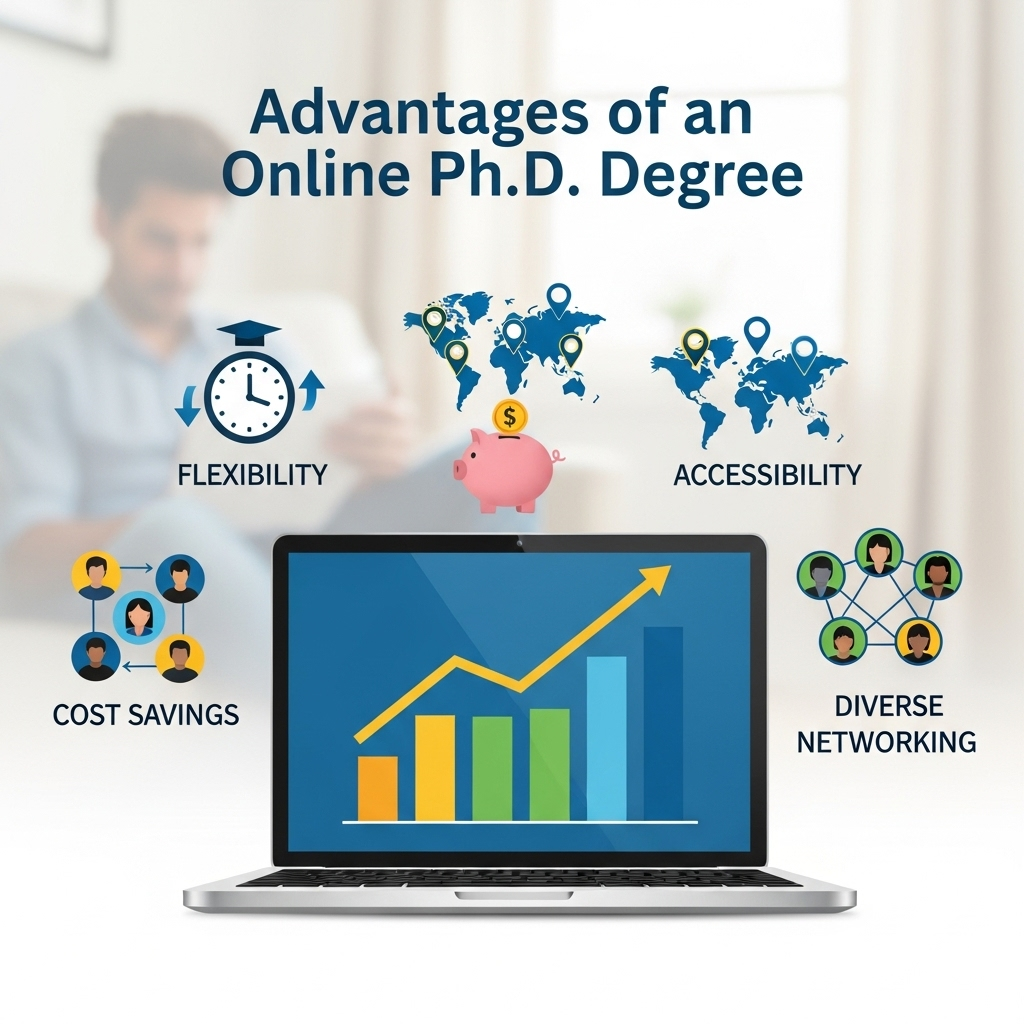
| Advantage | Description |
|---|---|
| Flexibility | Learn at your own pace with no need for full-time campus attendance |
| Work–Study Balance | Ideal for working professionals who want to advance without leaving their jobs |
| Global Access | Enroll in programs offered by universities worldwide, right from your location |
| Cost-Effective | Saves on travel, relocation, and sometimes tuition costs |
| Time Efficiency | Structured to help you complete your degree within a set timeline (3–6 years) |
| Technology-Enhanced Learning | Access to research tools, online libraries, virtual supervision, and e-resources |
| Equal Recognition | Many accredited online Ph.D. programs are equally recognized as on-campus ones |
| Broader Networking | Connect with global researchers and professionals through virtual platforms |
| Custom Research Topics | Allows focus on niche or industry-relevant topics aligned with your career |
Why Should You Pursue Ph.D. from Online Learning
An online Ph.D. offers a flexible, affordable, and accessible way to earn a doctorate without putting your career or personal life on hold. It’s ideal for professionals who want to deepen their expertise while maintaining work-life balance.
online Ph.D. programs allow students to conduct original research from anywhere in the world. Additionally, online learning often reduces overall costs, offers global networking opportunities, and empowers learners to balance work, study, and life—making it a smart and accessible pathway to earning the highest academic credential.
Key Benefits:
- Study anytime, anywhere
- Balance work, study, and family
- Lower travel and accommodation costs
- Access to global faculty and resources
- Ideal for working professionals
- Develop independent research skills
- Recognized and accredited by many top institutions
Top Online Ph.D. Specializations
Pursuing a Ph.D. online has become an increasingly attractive option for scholars and professionals aiming to deepen their expertise while maintaining career flexibility. Online Ph.D. programs are now available across a wide range of disciplines, offering research opportunities in both traditional and emerging fields. These specializations are designed to build advanced knowledge, encourage independent research, and prepare candidates for leadership roles in academia, industry, and public service. Below are some of the most popular and career-relevant online Ph.D. specializations today:
| Specialization | Focus Area |
|---|---|
| Ph.D. in Education | Educational leadership, curriculum design, teacher training, policy analysis |
| Ph.D. in Management | Business strategy, HRM, marketing, operations, and organizational behavior |
| Ph.D. in Psychology | Clinical, counseling, developmental, or organizational psychology |
| Ph.D. in Computer Science | AI, machine learning, cybersecurity, data science, and software systems |
| Ph.D. in Economics | Economic theory, international trade, econometrics, and policy studies |
| Ph.D. in Political Science | Political theory, public administration, governance, international relations |
| Ph.D. in Sociology | Social theory, gender studies, urban/rural sociology, and research methodology |
| Ph.D. in Public Administration | Public policy, governance, budgeting, and administrative reforms |
| Ph.D. in English Literature | Literary analysis, comparative literature, postcolonial studies, and linguistics |
| Ph.D. in Law | Legal theory, constitutional law, international law, and human rights |
Online Ph.D. in Education – Course Syllabus Overview
An Online Ph.D. in Education is a research-intensive program designed to develop scholars, academic leaders, and policy experts in the field of education. The syllabus typically blends theoretical frameworks with applied research and includes coursework in the early stages followed by original dissertation work.
| Semester 1 | Semester 2 | Semester 3 |
|---|---|---|
| Research Methodology in Education | Curriculum Design & Development | Educational Policy & Planning |
| Philosophy of Education | Educational Measurement & Evaluation | Comparative Education |
| Advanced Educational Psychology | Contemporary Issues in Education | Instructional Technology |
| Semester 4 | Semester 5 – 6 | Semester 7 - 8 |
|---|---|---|
| Advanced Statistical Methods in Education | Comprehensive Viva | Data Collection & Analysis |
| Inclusive & Special Education | Thesis Literature Review | Dissertation Writing |
| Proposal Development | Research Tools & Techniques | Thesis Submission & Viva Voce |
Ph.D. Specialization and Projects
Ph.D. specializations let you dive deep into a subject you’re passionate about, whether it’s science, management, law, or technology. Along with coursework, you’ll work on research projects that add new knowledge to your field. These projects help sharpen your skills, build expertise, and open doors to academic, research, and industry careers.

Ph.D. specializations:
- Business & Management
- Computer Science & IT
- Education
- Engineering & Technology
- Health Sciences
- Social Sciences & Humanities
- Law & Policy
- Environmental Studies
Ph.D. Projects :
- Artificial intelligence and machine learning
- Digital transformation in business
- Blockchain applications
- E-learning and education technology
- Smart cities and renewable energy
- Telemedicine and healthcare innovation
- Public health policy
- Climate change and sustainability
- Human rights and policy reforms
- Migration and social inequality
How Online Ph.D. Exams are Conducted?
Online Ph.D. exams are conducted through secure, digital platforms that ensure academic integrity while providing flexibility for remote learners. These assessments are carefully designed to evaluate a scholar’s understanding, research progress, and original contribution to the field. The process includes a mix of written exams, project evaluations, and a final viva voce (thesis defense), all carried out online using advanced proctoring and communication tools.
- Remote Proctored Exams – Conducted under live or AI-based surveillance via webcam and screen monitoring.
- Open-Book or Take-Home Tests – Timed assessments with plagiarism checks, ideal for theory-based questions.
- Continuous Assessments – Through assignments, research papers, discussion forums, and presentations.
- Online Viva Voce (Oral Defense) – Final thesis defense held via video conferencing with an academic panel.
- Digital Submissions – Thesis drafts, proposals, and final research work submitted through LMS or email.
- Timed Online Quizzes – Short tests conducted within limited time windows to assess subject knowledge.
- These methods make the examination process efficient, secure, and accessible to Ph.D. scholars worldwide.
Top 10 Online Ph.D. program in India and Abroad Universities/Colleges for Admission.
An online Ph.D. program allows students to pursue advanced research degrees through flexible, remote learning formats. These programs are designed for individuals who wish to deepen their expertise, contribute original research, and advance their careers without relocating or leaving their current professional roles. Admission typically requires a relevant master’s degree, a strong academic record, and a well-defined research proposal, with coursework and supervision conducted via digital platforms while maintaining academic rigor and recognized accreditation.
| University / Institution | Approx. Annual Fees | Location | Accreditation |
|---|---|---|---|
| Charles Sturt University | $5,000–$8,000 | Australia | Accredited by TEQSA |
| Maharshi Dayanand University | ₹18,000–₹28,000 | India | UGC-approved distance programs |
| Anadolu University | $2,000–$4,000 | Turkey | Accredited by Turkish Higher Education Council |
| University of Madras (Distance/Hybrid) | ₹30,000–₹40,000 | India | UGC-approved distance segments |
| Athabasca University | $4,000–$7,000 | Canada | Accredited by Ministry of Advanced Education, Alberta |
| Amity University (Hybrid) | ₹50,000–₹70,000 | India | UGC-approved |
| University of Edinburgh | $10,000–$15,000 | UK | Recognized & respected globally |
| Symbiosis Centre for Distance Learning | ₹48,000–₹65,000 | India | UGC-approved |
| University of the People | ~$4,000 total (tuition-free model) | USA (Online) | Accredited by DEAC & WASC |
| Annamalai University | ₹22,000–₹32,000 | India | UGC-approved distance program |
Entrance Exams for Online Ph.D. Programs
Entrance exams for online Ph.D. programs are designed to assess a candidate’s research aptitude, subject knowledge, and analytical skills. These tests often include components like written assessments, interviews, and evaluations of research proposals. Some programs may waive entrance exams for applicants with significant academic achievements or professional research experience, focusing instead on their prior qualifications and research potential.
Types of Entrance Exams
National Exams
- Research Aptitude Tests – Assess research methodology, data interpretation, and critical thinking.
- Standardized Tests – Such as GRE or GMAT for analytical and quantitative reasoning.
- Personal Interviews – Assess academic preparedness and research potential.
- Language Proficiency Tests – IELTS or TOEFL for non-native speakers.
- General Aptitude Exams – Test reasoning, quantitative skills, and comprehension.
- Subject-Specific Assessments – Discipline-based exams or portfolio reviews.
University-Specific Exams
In India, many universities offering online or hybrid Ph.D. programs conduct their own entrance exams to assess research aptitude and subject knowledge. For example, IGNOU conducts the IGNOU Ph.D. Entrance Exam, while Patna University organizes the Ph.D. Admission Test (PAT). Some institutions also accept scores from national-level exams like JEST. In abroad universities, there is no single standardized test for online Ph.D. admissions; instead, institutions use their own internal assessments, which may include research aptitude tests, subject-specific exams, proposal presentations, and interviews to evaluate a candidate’s readiness for doctoral-level research.
| Region | University / Institution | Entrance Exam Name or Process |
|---|---|---|
| India | IGNOU (Indira Gandhi National Open University) | IGNOU Ph.D. Entrance Exam – a written test comprising 50% research methodology and 50% subject-specific questions, followed by an interview (entrance carries 70% weight, interview 30%) |
| India | Patna University | Ph.D. Admission Test (PAT) – two papers: one on general/research aptitude and another on the specific subject; followed by an interview. Exemptions available for UGC/CSIR fellows and experienced staff |
| India | Various Public Institutes | JEST (Joint Entrance Screening Test) – used by 33 institutes across India (especially in Physics and Theoretical CS) for Ph.D. admissions and recognized as an alternative NET |
| Abroad | (Example institutions offering fully online or hybrid Ph.D.; these typically don’t have a fixed national-level exam but rely on internal assessments) | Entrance assessments such as online research aptitude tests, subject-specific exams, proposal presentations, and faculty interviews—tailored to program requirements but not standardized across institutions. |
Entrance Exam Scores and Waivers
In India, Ph.D. admissions usually require qualifying scores in exams like UGC NET, CSIR NET, GATE, or university-specific tests, with waivers granted to candidates holding an M.Phil., cleared national eligibility tests, or having notable research or professional experience. Globally, many universities accept standardized tests such as the GRE or GMAT, though top institutions often waive these for applicants with strong academic records, advanced degrees, published research, or relevant industry expertise, focusing instead on research proposals and interviews.
Waivers for Entrance Exams
Many universities offer entrance exam waivers for Ph.D. applicants who demonstrate strong academic or research credentials. In India, candidates with an M.Phil. degree, those who have cleared UGC NET, CSIR NET, GATE, or similar national-level exams, as well as university faculty, research fellows, and industry experts with notable publications, may be exempted. Globally, institutions often waive exams like the GRE or GMAT for applicants holding advanced degrees, substantial professional or research experience, or peer-reviewed publications, focusing instead on research proposals, academic records, and interviews.
Tips for Preparing for Entrance Exams
- Preparing for a Ph.D. entrance exam requires a strategic approach that balances subject expertise with research aptitude. Here are some effective tips:
- Understand the Exam Pattern & Syllabus – Review the official syllabus and weightage of sections like research methodology, subject-specific knowledge, and general aptitude.
- Focus on Research Methodology – Strengthen your understanding of research design, data analysis, and academic writing, as these are core parts of most Ph.D. exams.
- Revise Subject Knowledge – Brush up on key concepts, theories, and recent developments in your specialization.
- Practice Previous Years’ Papers – Attempt past question papers and mock tests to get familiar with exam timing and difficulty level.
- Strengthen Quantitative & Analytical Skills – Work on reasoning, statistics, and data interpretation questions.
- Read Research Papers – Go through academic journals to enhance your critical thinking and understanding of current trends.
- Time Management – Allocate fixed time slots for each section during practice to improve speed and accuracy.
- Stay Updated – Keep track of recent advancements and debates in your field.
- Maintain Consistency – Study regularly instead of cramming in the last few days.
- Take Care of Yourself – Rest, eat well, and keep stress in check to maintain peak performance.
Admission Procedure for Ph.D. Online Universities
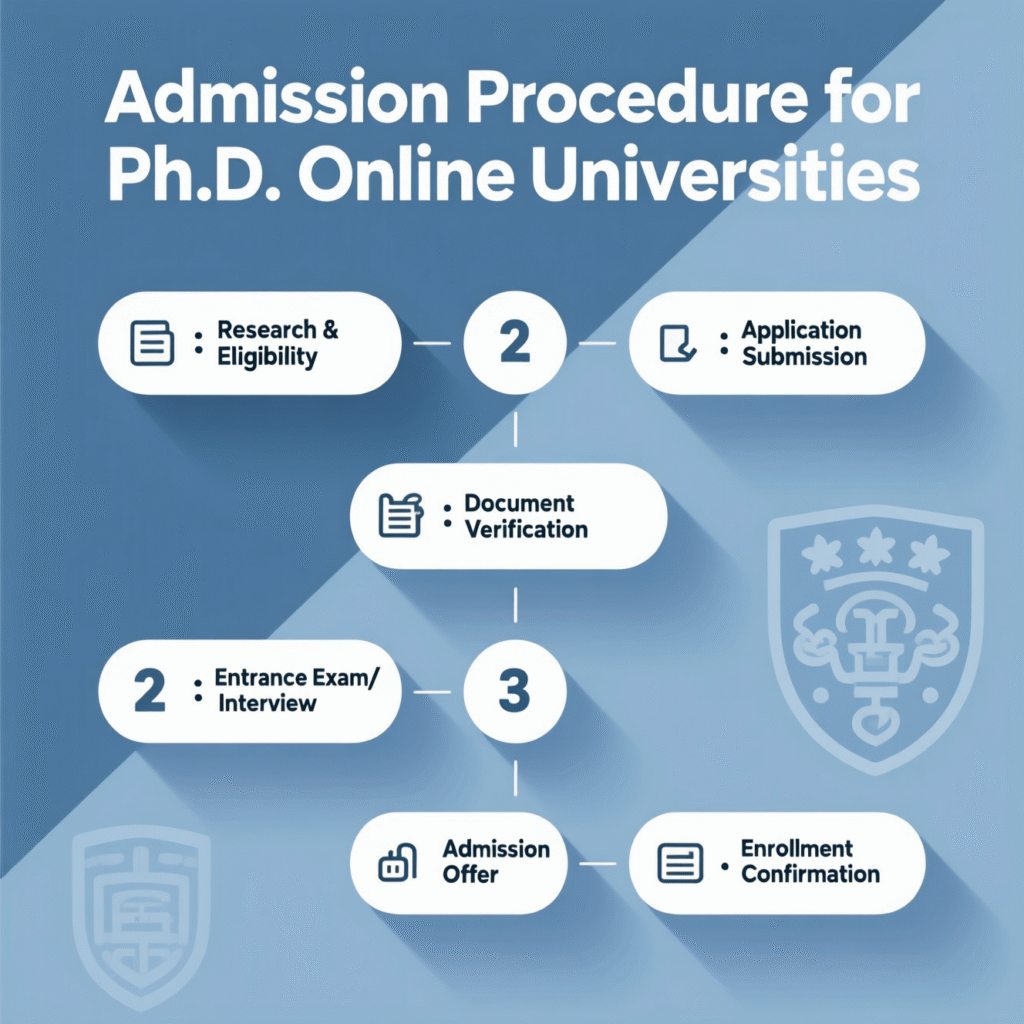
Admission to an online Ph.D. typically involves meeting eligibility criteria, submitting required documents, and completing an evaluation process. Most universities look for a relevant master’s degree, research proposal, and academic/professional background. Some may also require an entrance exam or interview.
- Application Form – Fill out the online application on the university portal.
- Eligibility Check – Master’s degree (sometimes bachelor’s with strong research/experience).
- Document Submission – Transcripts, CV, statement of purpose, research proposal, recommendation letters.
- Entrance Exam / Test (if applicable).
- Interview – Online or video-based discussion on research interests.
- Admission Offer – Acceptance letter with program details and fee structure.
- Enrollment & Orientation – Complete fee payment and start coursework/research.
Who Can Apply for Ph.D. Online Learning Courses?
Ph.D. online learning courses are designed for individuals who meet advanced academic and professional criteria and are seeking to pursue in-depth research without the constraints of a full-time, on-campus program. Applicants typically need a strong academic background, relevant research interests, and the ability to work independently. Many programs also welcome working professionals and international students, provided they meet the necessary admission requirements.
Who Can Apply:
- Master’s degree holders in a relevant field from a recognized university.
- Outstanding bachelor’s degree graduates (in direct-entry Ph.D. programs) with exceptional academic performance and research potential.
- Working professionals aiming to advance their qualifications while continuing employment.
- International students meeting academic, language, and visa (if applicable) requirements.
- Academics and educators seeking to strengthen research credentials.
- Industry experts with significant professional achievements, patents, or publications.
- Researchers already involved in independent or institutional projects.
- Government, healthcare, and policy professionals requiring advanced research skills.
- Part-time learners balancing doctoral studies with personal or professional commitments.
Online Ph.D. Acceptable in the Job Market?
An online Ph.D. from a reputable, accredited university is generally acceptable in the job market, particularly in sectors where research skills, analytical expertise, and subject mastery are valued. Employers focus on the credibility of the awarding institution, the quality of the dissertation or publications, and the candidate’s professional achievements rather than the study mode. However, recognition may vary depending on the country, industry, and employer policies, so accreditation and institutional reputation remain crucial.
Who Accepts Online Ph.D. Graduates :
- Universities & Colleges – For teaching, research, and administrative positions (if the degree is accredited).
- Research Institutes & Think Tanks – For roles in R&D, policy studies, and innovation projects.
- Technology Companies – For AI, data science, software research, and innovation leadership.
- Financial Institutions – For quantitative research, analytics, and risk modeling.
- Healthcare & Pharmaceutical Firms – For clinical research, medical science, and public health roles.
- Consulting Firms – For strategy, management, and policy advisory positions.
- Government & NGOs – For policy development, program management, and impact research.
Job Opportunities After Online Ph.D.
Earning an online Ph.D. can lead to a wide range of prestigious and high-impact career opportunities. Graduates are often sought after for their advanced research abilities, problem-solving expertise, and capacity to innovate in complex environments. Whether in academia, industry, government, or the non-profit sector, Ph.D. holders can pursue roles such as university professors, research scientists, policy advisors, senior consultants, and corporate leaders. Their qualifications open doors to positions in technology, healthcare, finance, education, and global policy-making, where evidence-based decision-making and specialized knowledge are highly valued.
| Sector | Common Roles | Estimated Salary Range |
|---|---|---|
| Academia & Education | Assistant Professor, Professor, Research Supervisor | ₹4 L – ₹30 L |
| Research & Development | Research Scientist, Principal Investigator | ₹7.5 L – ₹14 L |
| Technology & AI | Data Scientist, Machine Learning Engineer, AI Researcher | ₹10 L – ₹25 L |
| Healthcare & Pharma | Clinical Researcher, Medical Scientist | ₹6 L – ₹20 L |
| Finance & Analytics | Quantitative Analyst, Risk Modeler | ₹8 L – ₹30 L |
| Consulting & Policy | Strategy Consultant, Policy Analyst | ₹12 L – ₹40 L |
| Corporate Leadership | Innovation Director, Chief Research Officer | ₹30 L – ₹75 L |
| Patent & Legal Expertise | Patent Agent, Intellectual Property Specialist | ₹6 L - ₹30 L |
| Non-Profit & NGOs | Program Director, Research Coordinator | ₹5 L - ₹20 L |

Top Recruiters Hiring Online Ph.D. Graduates
Online Ph.D. holders are increasingly sought after by top employers across industries for their advanced research, analytical, and problem-solving skills. Leading recruiters include technology giants, financial institutions, research labs, and engineering firms, all of which value the depth of expertise and innovation that Ph.D. graduates bring. These roles often focus on AI, data science, R&D, policy, and high-level consultancy, with opportunities in both academia and industry.
| Industry | Top Recruiters / Companies | Common Roles |
|---|---|---|
| Technology & AI | Google, Microsoft, Meta, IBM | AI Scientist, Data Scientist, Research Engineer |
| Finance & Banking | JPMorgan Chase, Capital One, Citadel | Quant Analyst, Machine Learning Engineer |
| R&D & Engineering | Intel, Ericsson, Huawei, Bell Labs (Nokia) | Research Scientist, Product Development Lead |
| Academia & Education | University of Phoenix, Walden University, SNHU | Professor, Research Faculty |
| Consulting & Policy | McKinsey & Co., Deloitte, RAND Corporation | Policy Analyst, Strategy Consultant |
| Healthcare & Pharma | Pfizer, Johnson & Johnson, Mayo Clinic | Clinical Researcher, Medical Scientist |
FAQs - Frequently Asked Questions
Q1. What is the typical duration of a PhD program?
Most PhD programs take between 3–6 years to complete, depending on the field of study, research scope, and whether you are studying full-time or part-time.
Q2. Do I need a master’s degree to apply for a PhD?
Not always. Some universities allow direct entry into a PhD program after a bachelor’s degree, particularly if you have strong academic results and research experience.
Q3. How is a PhD assessed?
A PhD is usually assessed through the submission of an original thesis or dissertation and an oral defense (viva voce). Your work must demonstrate a significant contribution to the field.
Q4. Are PhD students paid or do they have to pay tuition?
This varies by country and institution. In some places, PhD students receive stipends or scholarships that cover tuition and living expenses. In others, students may need to secure funding or pay fees.
Q5. Can I work while doing a PhD?
Yes, but it depends on your program and funding conditions. Many full-time PhD students take on teaching or research assistant roles, while part-time students may work in their field alongside their studies.