
Online MA Program
(MA) Master of Arts program at Global Eduvarsity is a flexible, online postgraduate course designed to provide in-depth knowledge and expertise in arts, humanities, and social sciences. The program focuses on critical thinking, analytical skills, and subject mastery, preparing students for successful careers in education, research, media, public administration, and cultural sectors. With interactive online learning, practical projects, and globally recognized certification, the MA program at Global Eduvarsity offers a convenient pathway for working professionals and aspiring students to advance their academic and professional goals.
Online MA Program
The Master of Arts (MA) program at Global Eduvarsity is a flexible, online postgraduate course designed to provide in-depth knowledge and expertise in arts, humanities, and social sciences. The program focuses on critical thinking, analytical skills, and subject mastery, preparing students for successful careers in education, research, media, public administration, and cultural sectors. With interactive online learning, practical projects, and globally recognized certification, the MA program at Global Eduvarsity offers a convenient pathway for working professionals and aspiring students to advance their academic and professional goals.
Degree
Full Form
Duration
Eligibility
Semester Fee
postgraduate
Master’s of Arts
between 1 to 2 years
Bachelor’s degree
₹4,000 to ₹8,000
Degree
Full Form
Duration
Eligibility
Semester fee
Postgraduate
Master of Arts
Between 1 to 2 year
Bachelor's degree
₹6,000 to ₹25,000
What Is Online MA Course?
An Online Master of Arts (MA) course is a postgraduate program delivered entirely via the internet, allowing students to pursue advanced studies in arts, humanities, and social sciences from anywhere in the world. These programs offer flexible learning schedules, interactive online lectures, assignments, and projects, enabling working professionals and students to balance education with other commitments. Online MA courses often cover specializations like English, History, Psychology, Political Science, Sociology, and more, providing academic expertise and career advancement opportunities without the need to attend traditional on-campus classes.
Online MA Course Overview
The Online MA (Master of Arts) course offers advanced education in arts, humanities, and social sciences through a flexible online learning format. Designed for working professionals and students, the program emphasizes critical thinking, research skills, and subject mastery, helping learners achieve career growth and academic excellence without attending traditional on-campus classes.
| Feature | Details |
|---|---|
| Program Type | Online Postgraduate (MA) |
| Duration | 1–2 Years |
| Eligibility | Bachelor’s degree in relevant field |
| Specializations | English, History, Psychology, Political Science, Sociology, and more |
| Mode of Study | Online (Self-paced or Scheduled Classes) |
| Career Opportunities | Education, Research, Media, Public Administration, Cultural Sectors |
Eligibility Criteria and Duration for MA Online Learning
The Online MA program is designed for students who have completed a bachelor’s degree in a relevant field from a recognized university. It offers flexible learning options for working professionals, homemakers, and regular students seeking advanced education in arts, humanities, and social sciences.
Eligibility of MA Degree Course
| Criteria | Details |
|---|---|
| Eligibility | Bachelor’s degree in relevant discipline |
| Minimum Duration | 1 Year |
| Maximum Duration | 2 Years |
| Mode of Study | Online (Flexible / Self-paced) |
Additional Note: Some universities may offer direct admission based on academic performance, while others may require a personal interview or entrance test.
Duration of Online MA
| Program Type | Minimum Duration | Maximum Duration |
|---|---|---|
| Online MA (Full-Time) | 1 Year | 2 Years |
| Online MA (Part-Time) | 1 Year | 2 Years |
Note: Some universities may allow extensions beyond 2 years under special circumstances.
Advantages of an Online MA Degree
Pursuing an Online MA (Master of Arts) degree offers several benefits for students and working professionals alike. The program provides flexible learning schedules, access from anywhere, and the ability to balance education with work or personal commitments. It also helps in enhancing critical thinking, research skills, and subject expertise, making graduates more competitive in academia, media, education, and cultural sectors.
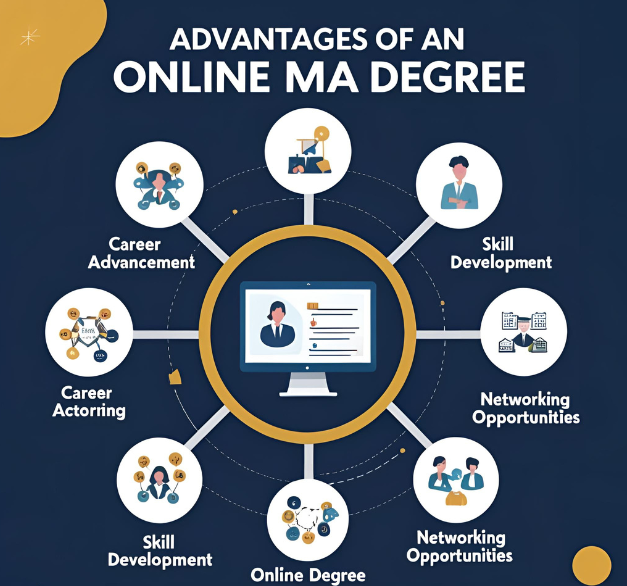
| Advantages | Details |
|---|---|
| Flexibility | Learn from anywhere at your own pace |
| Cost-Effective | Often cheaper than traditional on-campus programs |
| Career Advancement | Improves job prospects in education, media, research, and public sectors |
| Skill Enhancement | Develops research, writing, analytical, and critical thinking skills |
| Networking Opportunities | Connect with peers and experts worldwide through online platforms |
Why Should You Pursue MA from Online Learning
Pursuing an Online MA (Master of Arts) degree allows students and working professionals to advance their knowledge in arts, humanities, and social sciences without the need to attend on-campus classes. Online learning provides flexible schedules, self-paced study options, and access to global faculty and resources, making it ideal for balancing education with personal or professional commitments. Additionally, it enhances career prospects, research skills, and critical thinking abilities, preparing graduates for roles in education, research, media, public administration, and cultural sectors.
Key Benefits:
- Flexible learning from anywhere
- Affordable and cost-effective program
- Career advancement opportunities
- Development of research and analytical skills
- Networking with global experts and peers
Top Online MA Specializations
Online MA programs offer a wide range of specializations in arts, humanities, and social sciences, allowing students to focus on their areas of interest and career goals. These specializations provide opportunities to gain in-depth knowledge, enhance research skills, and develop expertise in specific domains.
| Specialization | Focus Area / Key Skills |
|---|---|
| MA in English Literature | Literary analysis, critical thinking, writing skills |
| MA in Psychology | Human behavior, counseling, research methodologies |
| MA in Political Science | Governance, public policy, international relations |
| MA in Sociology | Social research, societal trends, community studies |
| MA in History | Historical research, archival study, cultural heritage |
| MA in Education | Teaching methods, curriculum design, educational research |
| MA in Public Administration | Management, policy planning, administrative skills |
| MA in Mass Communication | Media studies, journalism, digital communication |
| MA in Fine Arts | Creativity, art history, practical artistic skills |
| MA in International Relations | Diplomacy, global politics, conflict resolution |
Online MA in Education – Course Syllabus Overview
The Online MA in Education program is designed to develop advanced knowledge in teaching methodologies, curriculum design, educational research, and leadership in the field of education. The program typically spans 4 semesters and combines theoretical knowledge with practical applications.
| Semester | Course / Subject Area | Key Topics / Focus Areas |
|---|---|---|
| Semester 1 | Foundations of Education | Philosophical and sociological perspectives, history of education, education in contemporary society |
| Semester 2 | Educational Psychology & Learning Theories | Cognitive development, learning models, student motivation, assessment strategies |
| Semester 3 | Curriculum Design & Instructional Leadership | Curriculum planning, instructional strategies, classroom management, leadership in education |
| Semester 4 | Research Methods & Dissertation / Project | Quantitative and qualitative research methods, project report, dissertation writing, educational research ethics |
MA Specialization and Projects

The MA in Education program offers various specializations allowing students to focus on their areas of interest while developing expertise in modern educational practices. Students also complete project work or a dissertation to apply theoretical knowledge in practical settings.
Specializations:
- Educational Leadership and Management – Focus on school administration, policy implementation, and leadership skills.
- Inclusive Education – Strategies and methodologies to educate students with diverse learning needs.
- Educational Technology – Integration of digital tools, e-learning, and innovative teaching practices.
- Early Childhood Education – Child development, pedagogy, and curriculum design for young learners.
- Higher Education Studies – Curriculum planning, quality assurance, and research in higher education.
Projects / Dissertation:
- Students are required to complete a research project or dissertation in their chosen specialization.
- Projects involve research design, data collection, analysis, and practical application of educational theories.
- Typical topics include curriculum evaluation, instructional methods, e-learning implementation, and educational policy studies.
How Online MA Exams are Conducted?
Online MA exams are designed to evaluate a student’s understanding of the course material, research skills, and practical application of concepts. These exams are conducted entirely through online learning platforms, providing flexibility and accessibility to students worldwide.
Key Features of Online MA Exams:
- Mode: Exams are conducted online via secure learning management systems (LMS).
- Format: Can include multiple-choice questions (MCQs), short answers, essay-type questions, and case study analyses.
- Assignments & Projects: Continuous assessment through assignments, presentations, and project submissions.
- Dissertation / Thesis Evaluation: Final semester often includes submission and defense of a dissertation or research project.
- Proctoring: Some universities use online proctoring software to monitor exams and ensure academic integrity.
- Flexibility: Students can often choose exam timings within a specified window.
Additional Notes:
- Exams are designed to reflect both theoretical knowledge and practical application.
- Feedback is provided digitally to guide student improvement.
Top 10 Online MA program in India and Abroad Universities/Colleges for Admission.
Pursuing an Online MA degree offers flexibility, accessibility, and the opportunity to study from reputed universities across India and abroad. These programs are ideal for working professionals, international students, and those looking to advance their knowledge in specialized fields of arts, humanities, and social sciences.
| University / College | Country | Popular MA Specializations | Mode |
|---|---|---|---|
| IGNOU | India | English, Education, Sociology | Online |
| Amity University | India | Psychology, Education, Political Science | Online |
| University of London | UK | International Relations, History | Online |
| University of Edinburgh | UK | Education, Global Studies | Online |
| University of Melbourne | Australia | Arts, Education, Media | Online |
| Walden University | USA | Psychology, Education, Public Policy | Online |
| University of Oxford | UK | History, Literature | Online |
| University of Leicester | UK | Education, Management | Online |
| Amrita Vishwa Vidyapeetham | India | English, Public Administration | Online |
| University of Delhi | India | Political Science, Sociology, Education | Online |
Entrance Exams for Online MA Programs
Many online MA programs do not require traditional entrance exams, making admission flexible and accessible for students worldwide. However, some reputed universities may require qualifying exams, personal interviews, or written tests depending on the specialization and eligibility criteria.
Key Points:
- Direct Admission: Many universities offer direct admission based on previous academic performance.
- University-Specific Tests: Some universities may conduct their own online entrance exams for assessment.
- English Proficiency Tests: For international students, tests like IELTS or TOEFL may be required.
- Professional Experience: Certain programs may consider professional experience in lieu of entrance exams.
- Note: Always check the specific requirements of the university before applying.
Types of Entrance Exams
National Exams
- India: Exams like NTA NET (National Eligibility Test) and UGC NET are sometimes considered for MA admissions, especially in humanities and social sciences.
- USA & Canada: National exams are usually not required for MA, but standardized tests like GRE may be requested by some institutions.
- UK & Europe: Admissions are generally based on prior academic performance, but some competitive programs may have national assessment criteria.
- Note: National exams vary by country and specialization, so candidates should verify specific requirements for their chosen MA program.
University-Specific Exams
Some universities conduct their own entrance exams for MA admissions, especially for specialized or high-demand programs. These exams assess academic aptitude, subject knowledge, and sometimes critical thinking skills to ensure candidates meet the program’s requirements.
| Region | University / Institution | Entrance Exam Name |
|---|---|---|
| India | Jawaharlal Nehru University | CEEB (MA Entrance Exam) |
| India | University of Delhi | DU MA Entrance Test |
| India | Jamia Millia Islamia | JMI MA Entrance Exam |
| UK | University of Oxford | Oxford MA Admissions Test |
| UK | University of London | London MA Online Assessment |
| USA | Columbia University | Columbia MA Program Assessment |
| Australia | University of Melbourne | MEL MA Online Entrance Exam |
Entrance Exam Scores and Waivers
For admission into a Master’s (MA) program, applicants are generally required to submit entrance exam scores such as the GRE or other program-specific tests. However, many institutions offer waivers for these exams based on factors like prior academic performance, professional experience, or completion of certain qualifying degrees. Applicants seeking a waiver must typically provide supporting documents and meet the eligibility criteria set by the university.
Waivers for Entrance Exams
Many Master’s (MA) programs offer waivers for entrance exams for eligible applicants. Waivers are often granted based on strong academic performance, relevant professional experience, or prior degrees from recognized institutions. Applicants usually need to submit supporting documents to demonstrate eligibility, and the final decision rests with the admissions committee.
Tips for Preparing for Entrance Exams
- Understand the Syllabus: Review the exam syllabus thoroughly to identify key topics.
- Create a Study Plan: Allocate regular study hours and set achievable goals.
- Practice Past Papers: Solve previous years’ questions to get familiar with the exam format and timing.
- Strengthen Core Skills: Focus on writing, analytical, and reasoning abilities.
- Join Study Groups or Coaching: Seek guidance or collaborate with peers for better preparation.
- Time Management: Practice managing time effectively during both preparation and the exam.
- Stay Updated: Keep up with relevant academic material and current developments in your field.
Admission Procedure for MA Online Universities
- Online Application: Fill out and submit the university’s online application form.
- Document Submission: Provide transcripts, identification, statement of purpose, and any other required documents.
- Recommendation Letters: Submit letters of recommendation if required by the program.
- Entrance Exam (if applicable): Submit scores for any required entrance exams or assessments.
- Interview/Assessment: Attend an interview or complete any additional assessments if requested.
- Admission Offer: Receive the admission confirmation from the university.
- Enrollment & Fee Payment: Complete enrollment by paying program fees and registering for courses through the online portal

Who Can Apply for MA Online Learning Courses?
- Bachelor’s Degree Holders: Individuals who have completed a recognized undergraduate degree.
- Working Professionals: Those seeking to enhance skills or advance their careers while continuing to work.
- International Students: Applicants from other countries who meet the program’s admission requirements.
- Students Seeking Flexibility: Individuals looking for flexible learning schedules and online course delivery.
- Applicants Meeting Specific Criteria: Candidates who satisfy minimum GPA, relevant academic background, or professional experience requirements set by the university.
Online MA Acceptable in the Job Market?
Online MA degrees are increasingly recognized and accepted in the job market, especially when obtained from accredited and reputable universities. Employers value the knowledge, skills, and self-discipline demonstrated by candidates who complete online programs. The degree’s acceptance may vary depending on the industry, employer, and the program’s reputation, so choosing a well-established institution is important for maximizing career opportunities.
Who Accepts Online MA Program :
- Accreditation Matters: Degrees from accredited universities are widely accepted.
- Skill Recognition: Employers value the expertise and self-discipline gained through online learning.
- Industry Variation: Acceptance may vary depending on the field and employer preferences.
- Reputation Counts: Degrees from well-known institutions carry more weight in the job market.
- Career Advancement: Online MA programs can enhance qualifications and open new professional opportunities.
Job Opportunities After Online MA
An online MA opens up diverse career opportunities across sectors such as education, management, social sciences, and the corporate world. Graduates can pursue roles that match their specialization while benefiting from the flexibility and skills gained through online learning.
| Specialization/Field | Possible Job Roles | Sector |
|---|---|---|
| Management & Business | Project Manager, HR Manager, Business Analyst | Corporate / Private |
| Education & Teaching | Lecturer, Academic Coordinator, Curriculum Designer | Schools / Colleges |
| Social Sciences | Research Analyst, Policy Advisor, Counselor | NGOs / Government |
| Humanities & Arts | Content Writer, Editor, Cultural Manager | Media / Arts / NGOs |
| Technology & IT (relevant MA) | Data Analyst, Digital Marketing Manager, UX Researcher | IT / Tech Companies |
Top Recruiters Hiring Online MA Graduates
Online Master of Arts (MA) graduates are increasingly sought after by top recruiters across various sectors in India. These companies value the diverse skill sets and critical thinking abilities that MA graduates bring, making them ideal candidates for roles in education, content creation, research, and more.
| Company | Sector | Roles for MA Graduates |
|---|---|---|
| Tata Consultancy Services (TCS) | IT & Consulting | Content Analyst, Research Associate |
| Infosys | IT & Consulting | Business Analyst, Research Analyst |
| Amazon | E-commerce & Technology | Content Strategist, Research Associate |
| Wipro | IT & Consulting | Content Developer, Research Analyst |
| Capgemini | IT & Consulting | Business Analyst, Research Associate |
| Vedantu | EdTech | Content Developer, Subject Matter Expert |
| Avtar Group | HR & DEI Consulting | Diversity Analyst, HR Researcher |
| Randstad India | HR Consulting | Recruitment Consultant, Talent Acquisition Partner |
FAQs - Frequently Asked Questions
Q1. Can I switch fields after completing an MA?
Yes! An MA equips you with transferable skills like critical thinking, research, and communication, allowing you to transition into fields like marketing, consulting, or digital media even if your specialization was in humanities.
Q2. How valuable is an MA in today’s job market?
An MA is highly valuable for roles requiring analytical and research skills, problem-solving, and effective communication. Many organizations seek MA graduates for positions in education, content strategy, policy, and social research.
Q3. Can I work while pursuing an MA online?
Absolutely. Online MA programs are designed for flexibility, letting you balance work and study while gaining advanced knowledge in your field.
Q4. How do I choose the right MA specialization?
Consider your career goals, interests, and emerging industry trends. For example, Psychology or Sociology suits research and counseling roles, while Economics or Political Science can lead to policy or administrative careers.
Q5. Are internships important during an MA?
Yes. Internships provide hands-on experience, networking opportunities, and can significantly boost employability after graduation. Many online MA programs also offer virtual internship options.