
Online LLM Program

The LLM program at Global Eduvarsity is designed for law graduates and professionals who want to advance their legal expertise and specialize in emerging fields of law. With a flexible online learning model, the course combines academic excellence, practical insights, and global exposure, preparing students for careers in law firms, corporate sectors, government bodies, and international organizations.
Online LLM Program
The LLM program at Global Eduvarsity is designed for law graduates and professionals who want to advance their legal expertise and specialize in emerging fields of law. With a flexible online learning model, the course combines academic excellence, practical insights, and global exposure, preparing students for careers in law firms, corporate sectors, government bodies, and international organizations.
Degree
Full Form
Duration
Eligibility
Semester fee
Postgraduate
Master of Laws
Between 1 to 2 year
Bachelor's of Laws degree
₹25,000 to ₹1,50,000
Degree
Full Form
Duration
Eligibility
Semester fee
postgraduate
Master of Commerce
Between 1 to 2 years
Bachelor's degree
₹15,000 to ₹25,000
What Is Online LLM Course?
An Online LLM (Master of Laws) course is a postgraduate law degree pursued through virtual learning platforms, designed for law graduates and professionals who want to specialize in a particular area of law while maintaining flexibility. Unlike traditional classroom programs, online LLMs allow students to study remotely, access recorded/live lectures, interact with faculty online, and complete assignments digitally.
Key Highlights:
- Eligibility: Requires an LLB or equivalent law degree.
- Duration: Usually 1–2 years, depending on university and study mode.
- Specializations: International Law, Corporate Law, Intellectual Property Law, Human Rights Law, Taxation Law, Arbitration, Cyber Law, etc.
- Learning Mode: 100% online or hybrid (live classes + recorded lectures + online resources).
- Career Outcomes: Legal consultants, corporate lawyers, compliance officers, academics, policy advisors, and international legal experts.
Online LLM Course Overview
An Online LLM (Master of Laws) is a flexible postgraduate degree designed for law graduates and professionals seeking to specialize in fields like Corporate Law, International Law, Human Rights, or Intellectual Property. Delivered via digital platforms, it offers global exposure, interactive learning, and career advancement opportunities—all without requiring relocation or a career break.
| Feature | Details |
|---|---|
| Eligibility | LLB or equivalent law degree |
| Duration | 1–2 years (varies by university & study mode) |
| Learning Mode | 100% Online / Hybrid (live lectures, recorded classes, digital resources) |
| Specializations | Corporate Law, International Law, Human Rights, IPR, Taxation, Cyber Law |
| Career Roles | Legal Consultant, Corporate Lawyer, Compliance Officer, Policy Advisor, Academic |
| Who Should Apply | Law graduates, working legal professionals, international law aspirants |
Eligibility Criteria and Duration for LLM Online Learning
If you’re thinking about an Online LLM, the entry requirements are pretty straightforward. You’ll need a law background—usually an LLB or an equivalent degree. Some universities may ask for a minimum percentage (around 50–55%) and, in a few cases, a bit of work experience if the course is designed for professionals. For international programs, you might also need an English proficiency test like IELTS or TOEFL.
Eligibility:
- LLB or equivalent degree (mandatory)
- 50–55% marks in law degree (typical requirement)
- Work experience (optional, but preferred for some global programs)
- English proficiency tests for international applicants (IELTS/TOEFL)
Duration:
- Full-time: 1 year
- Part-time/Flexible: 2 years
- Extended mode: Up to 3–5 years (depending on university rules)
Advantages of an Online LLM Degree
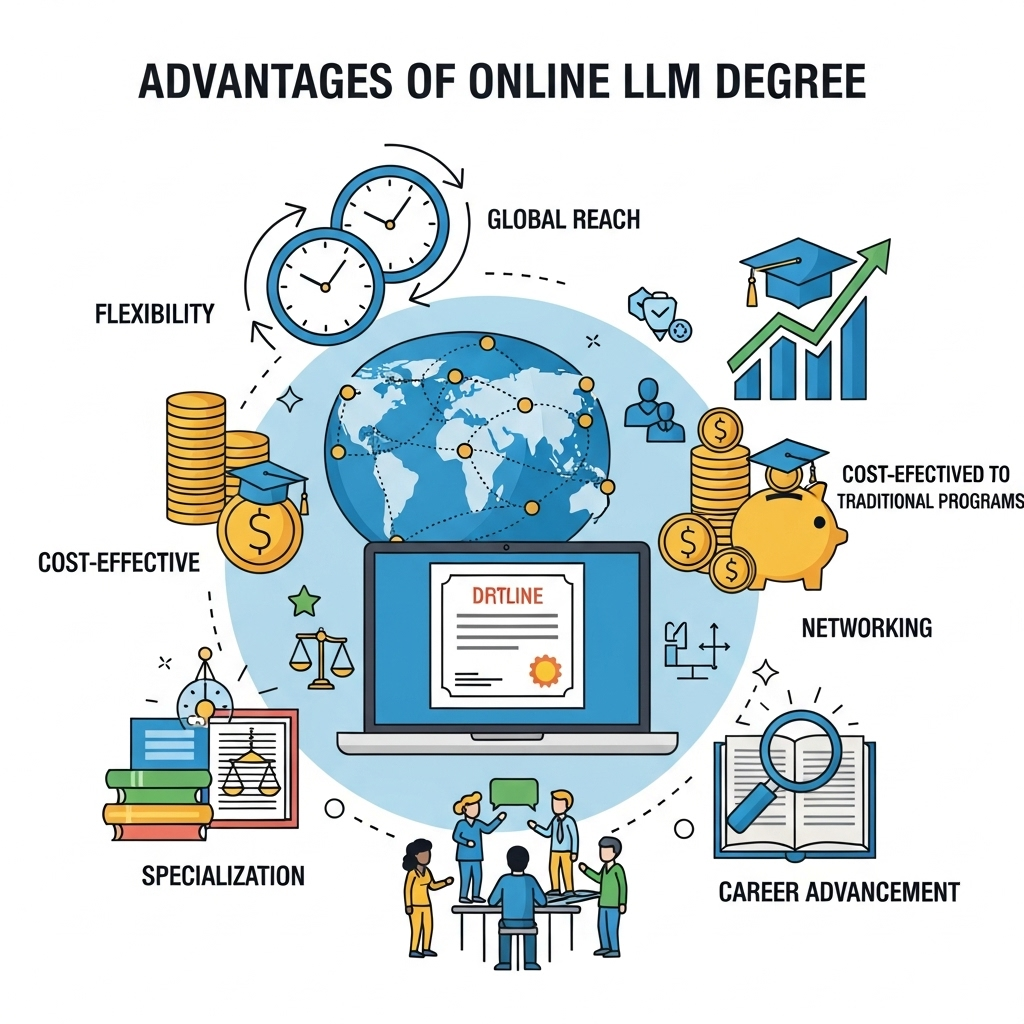
Online LLM is perfect if you want to grow in your legal career without putting life on pause. It lets you specialize in exciting areas of law, connect with global peers, and study on your own terms—all while balancing work and personal commitments. Plus, it’s often lighter on the wallet compared to a traditional on-campus program.
- Flexibility – Study from anywhere, at your own pace, without having to leave your job or relocate.
- Global Exposure – Learn from international faculty and interact with peers across the world.
- Specialization Options – Choose niche areas like Corporate Law, International Law, Cyber Law, Human Rights, or Intellectual Property.
- Career Growth – Boosts career prospects in law firms, corporates, policy organizations, and academia.
- Cost-Effective – Often more affordable than on-campus programs, with savings on relocation and living expenses.
- Work-Study Balance – Designed for working professionals to continue gaining experience while studying.
- Technology-Enhanced Learning – Access to recorded lectures, virtual moot courts, legal databases, and e-libraries.
- Pathway to Global Careers – Many online LLMs are recognized internationally, opening doors to jobs abroad.
Why Should You Pursue LLM from Online Learning
An Online LLM is ideal for law graduates and working professionals who want to advance their legal expertise without pausing their career. It offers flexibility, cost savings, and global exposure, letting you specialize in areas of law that match your career goals.
Key Benefits:
- Study anytime, anywhere at your own pace
- Continue working while earning your degree
- Save on relocation and living expenses
- Access international faculty and diverse classmates
- Choose from multiple specializations like Corporate, International, Cyber, or Human Rights Law
- Enhance career prospects both locally and globally
Top Online LLM Specializations
Online LLM programs offer a variety of specializations that let you focus on the legal fields most relevant to your career goals. Whether you’re interested in corporate law, technology, or human rights, these programs provide flexible learning and global exposure.
| Specialization | Focus Area / Career Path |
|---|---|
| Corporate Law | Mergers & acquisitions, contracts, corporate governance |
| International Law | Cross-border disputes, treaties, global legal systems |
| Intellectual Property Law | Patents, trademarks, copyrights, IP management |
| Human Rights Law | Social justice, NGOs, policy-making |
| Cyber Law / IT Law | Data protection, cybersecurity, e-commerce regulations |
| Taxation & Financial Law | Corporate tax, compliance, financial regulations |
| Arbitration & Dispute Resolution | Mediation, international arbitration, conflict resolution |
Online LLM in Education – Course Syllabus Overview
Online LLM in Education focuses on the legal aspects of education, including policy, governance, intellectual property, and compliance in educational institutions. The program is designed for law graduates, educators, and education administrators who want to specialize in education law while continuing their professional commitments.
| Semester 1 | Semester 2 | Semester 3 | Semester 4 |
|---|---|---|---|
| Legal Systems and Jurisprudence | Educational Policy and Governance | Dispute Resolution in Educational Institutions | Dissertation / Capstone Project |
| Education Law: Foundations & Principles | Intellectual Property in Education | International Education Law | Emerging Issues in Education Law (E-learning, Digital Rights) |
| Constitutional & Human Rights in Education | Administrative Law & Regulatory Frameworks | Research Methodology & Legal Writing | Ethics & Compliance in Education |
LLM Specialization and Projects

LLM programs allow students to specialize in a particular area of law while applying theoretical knowledge through practical projects or dissertations. These projects help develop research, analytical, and problem-solving skills relevant to the legal profession.
Specialization :
- Corporate Law
- International Law
- Intellectual Property Law (IPR)
- Human Rights Law
- Cyber / IT Law
- Taxation & Financial Law
- Arbitration & Dispute Resolution
- Environmental Law
- Education Law
- Health & Medical Law
- Competition / Antitrust Law
- Maritime & Transport Law
- Sports & Entertainment Law
- Energy & Natural Resources Law
- Family and Succession Law
- Labour and Employment Law
- Immigration and Asylum Law
- Space and Technology Law
Projects :
- Corporate compliance analysis
- Mergers & acquisitions case study
- Drafting corporate policies and contracts
- International treaty research
- Cross-border dispute resolution study
- Intellectual property portfolio development
- Copyright/patent infringement case analysis
- Human rights advocacy research
- NGO policy and program evaluation
- Cybersecurity and data protection audit
- E-commerce regulation research
- Tax compliance and financial regulations study
- Arbitration or mediation simulation
- Environmental law compliance project
- Education policy and school/university legal framework study
- Healthcare regulations and bioethics case research
- Sports or entertainment contract analysis
- Renewable energy and natural resources legal assessment
How Online LLM Exams are Conducted?
Online LLM programs usually conduct exams and assessments remotely, allowing students to complete tests from anywhere. These exams are designed to maintain academic integrity through timed tests, proctoring software, and project-based evaluations. They combine theory, application, and research skills to ensure a comprehensive assessment of your legal knowledge.
Common Online LLM Exam Formats:
- Multiple Choice Questions (MCQs) – Testing core legal concepts
- Open Book Exams – Analysis-based questions allowing reference materials
- Case Studies – Application of law to real-life scenarios
- Assignments / Research Papers – In-depth exploration of a legal topic
- Presentations / Moot Simulations – Practical demonstration of legal reasoning
- Proctored Online Exams – Supervised via webcam or secure software
Top 10 Online LLM program in India and Abroad Universities/Colleges for Admission.
Online LLM programs offer flexible, career-oriented legal education for law graduates and working professionals. These programs let students specialize in areas like Corporate Law, International Law, Intellectual Property, Cyber Law, and Human Rights, while studying remotely from anywhere in the world. Both Indian and international universities provide structured courses with interactive sessions, research projects, and practical assessments.
| University / College | Location | Specializations / Focus Areas |
|---|---|---|
| O.P. Jindal Global University | India | Business Law, IPR, International Trade Law |
| University of Edinburgh | UK | International Business Law |
| Amity Law School | India | Criminal Law, Family Law, IPR |
| King’s College London | UK | International Law, Commercial Law |
| Symbiosis Law School | India | Corporate & Commercial Law, IPR, Trade Law |
| University of Liverpool | UK | International Business Law |
| NALSAR University of Law | India | International Law, Cyber Law, IPR |
| University of Southern California (USC) Gould | USA | Business Law, Compliance |
| National Law University, Delhi | India | Constitutional Law, IPR, ADR |
| Liberty University | USA | International Legal Studies |
Entrance Exams for Online LLM Programs
Most universities offering an Online LLM provide admission through direct enrollment based on graduation (LLB or equivalent) marks. However, some universities in India and abroad may still consider entrance exams or require English proficiency tests for international students.
Common Entrance Exams for Online LLM:
- CLAT-PG – Common Law Admission Test for postgraduate law programs (India).
- AILET-PG – All India Law Entrance Test for LLM admissions (India).
- LSAT – Law School Admission Test (accepted globally).
- TOEFL / IELTS / Duolingo – For abroad Online LLM programs (English proficiency).
- University-specific tests – Some universities may have their own admission tests or interviews.
👉 In short: Many Online LLM programs don’t need entrance exams, but recognized tests may apply depending on the university.
Types of Entrance Exams
National Exams
- LSAT (USA & Canada) – Law School Admission Test, widely accepted for LLM admissions.
- Bar Exam Eligibility Tests (USA States) – Some online LLMs require prior bar exam eligibility.
- LNAT (UK) – Law National Aptitude Test (mainly for undergrad, but some universities consider for LLM entry background).
- TOEFL / IELTS (Global) – Required in many countries as national/proficiency benchmarks.
- DAAD Requirements (Germany) – German Academic Exchange standards for law programs.
- All India CLAT-PG & AILET (India) – Recognized in India but sometimes accepted by global collaborations.
👉 Most Online LLM programs abroad focus on English proficiency tests (TOEFL/IELTS) instead of heavy entrance exams.
University-Specific Exams
- Harvard Law School (USA) – May require LSAT/GRE scores + internal evaluation of legal writing.
- Oxford University (UK) – Own application test + academic review for LLM/Online law programs.
- Cambridge University (UK) – Written assessment + interview for law applicants.
- National Law Universities (India, e.g., NLSIU, NLU Delhi) – Conduct CLAT-PG / AILET-PG as university-specific entrance exams.
- University of London (UK) – Direct admission for Online LLM but may require prior law background checks.
- McGill University (Canada) – Requires law background and may have internal evaluation.
👉 Many global universities offering Online LLMs waive standardized tests and instead rely on internal application reviews, essays, or interviews.
Entrance Exam Scores and Waivers
For Online LLM programs, many universities waive entrance exams and offer direct admission based on academic performance in LLB or equivalent degrees. However, some institutions may still ask for exam scores like CLAT-PG, LSAT, or TOEFL/IELTS (for international students). Waivers are often granted to candidates with strong academic backgrounds, relevant work experience, or prior legal qualifications.
Waivers for Entrance Exams
Many universities offering Online LLM programs provide waivers for entrance exams to make admissions more flexible. Instead of requiring scores like CLAT-PG, LSAT, or TOEFL/IELTS, they often admit students directly if they meet certain criteria.
Waiver Cases for Online LLM:
- Strong Academic Record – High GPA in LLB or equivalent degree.
- Work Experience – Legal practice, corporate law, or relevant professional background.
- International Exposure – Prior studies or work in English-speaking countries.
- UGC/Accredited Universities – Recognition of prior education from approved institutions.
- Internal Assessments – Some universities replace entrance exams with personal interviews or essays.
Tips for Preparing for Entrance Exams
- Understand the Syllabus – Focus on Constitutional Law, Jurisprudence, Contracts, and Current Affairs.
- Use Standard Study Materials – Refer to past papers, law guides, and legal casebooks.
- Make a Study Schedule – Divide topics weekly and stick to consistent practice.
- Practice Mock Tests – Take online quizzes to improve speed and accuracy.
- Focus on Legal Reasoning – Strengthen analytical thinking with case-based questions.
- Stay Updated – Read daily legal updates, judgments, and current affairs.
- Stay Calm & Revise – Keep revising important laws and maintain exam-day confidence.
 In short: Consistent study + practice with mock tests + legal awareness = success in Online LLM entrance exams.
Admission Procedure for LLM Online Universities

Getting into an Online LLM program is usually simpler than traditional LLM programs, but it still involves a few key steps to ensure eligibility and readiness. Most universities focus on academic background, legal knowledge, and professional experience, rather than intensive entrance exams.
- Check Eligibility – Ensure you have an LLB or equivalent law degree; some universities may require minimum marks or work experience.
- Research Programs – Shortlist universities and specializations based on career goals, course structure, and duration.
- Prepare Documents – Commonly required: academic transcripts, degree certificates, CV/resume, and identification proof.
- Submit Online Application – Fill out the university’s online application portal with personal, academic, and professional details.
- Entrance Exam / Test (if applicable) – Some Indian universities may ask for CLAT-PG, LSAT, or university-specific tests; international programs usually require English proficiency (IELTS/TOEFL).
- Interview / Statement of Purpose (if applicable) – Some programs may conduct an online interview or ask for a statement of purpose.
- Admission Offer & Fee Payment – Once selected, you’ll receive an admission offer, followed by online fee payment to confirm your seat.
- Enrollment & Orientation – After admission, you get access to online portals, course materials, and orientation sessions.
Who Can Apply for LLM Online Learning Courses?
- Law graduates with an LLB or equivalent degree
- Candidates with a minimum academic score (usually 50–55% in LLB)
- Working professionals in legal roles (lawyers, legal advisors, compliance officers)
- Educators or academics in law or related fields
- Candidates with 1–3 years of work experience (optional/preferred by some programs)
- International students with proof of English proficiency (IELTS/TOEFL)
- Anyone seeking specialization in areas like Corporate Law, International Law, Cyber Law, Human Rights, or Intellectual Property
Online LLM Acceptable in the Job Market?
Online LLM is widely accepted, especially if it’s from a reputable and accredited university. Employers today focus more on your skills, specialization, and practical knowledge than whether you studied on-campus or online. Online LLM graduates can pursue careers in law firms, corporate legal departments, compliance, international organizations, NGOs, and academia.
Key Points:
- Recognized universities ensure the degree is valid for employment and further studies.
- Employers value specialized knowledge in areas like Corporate Law, International Law, Cyber Law, or Intellectual Property.
- Online LLMs are particularly suitable for working professionals, allowing career growth without taking a break.
- Networking, internships, and project work during the program enhance employability.
Job Opportunities After Online LLM
Online LLM opens doors to diverse legal and policy-oriented careers. Graduates can work in law firms, corporate legal departments, government agencies, international organizations, NGOs, and academia. The degree also enables specialization in areas like Corporate Law, International Law, Cyber Law, and Intellectual Property, increasing employability and career growth opportunities.
| Specialization/Field | Possible Job Roles | Sector |
|---|---|---|
| Management & Business | Project Manager, HR Manager, Business Analyst | Corporate / Private |
| Education & Teaching | Lecturer, Academic Coordinator, Curriculum Designer | Schools / Colleges |
| Social Sciences | Research Analyst, Policy Advisor, Counselor | NGOs / Government |
| Humanities & Arts | Content Writer, Editor, Cultural Manager | Media / Arts / NGOs |
| Technology & IT (relevant MA) | Data Analyst, Digital Marketing Manager, UX Researcher | IT / Tech Companies |

Top Recruiters Hiring Online LLM Graduates
Online LLM graduates are in demand across corporate law, consulting, financial services, NGOs, and government sectors. Employers value their specialized legal knowledge, analytical skills, and flexibility. Leading law firms, multinational corporations, and international organizations actively hire graduates from accredited online LLM programs.
| Recruiter / Organization | Sector / Role Type | Typical Opportunities |
|---|---|---|
| Amarchand & Mangaldas | Law Firm | Corporate Lawyer, Legal Consultant |
| Cyril Amarchand Mangaldas | Law Firm | M&A, Compliance, Litigation |
| KPMG, Deloitte, PwC | Consulting / Financial Services | Legal Advisor, Compliance Officer |
| Microsoft, Google, Amazon | Tech / Corporate Legal Teams | IP Lawyer, Cyber Law Specialist |
| United Nations / UN Agencies | International Organizations | Human Rights, Policy Advisor |
| NGOs (Amnesty International, Red Cross) | Non-Governmental Organizations | Advocacy, Legal Research |
| Government Legal Departments | Public Sector | Legal Advisor, Policy Drafting |
| Bar Council / Law Chambers | Legal Practice | Litigation, Arbitration, Dispute Resolution |
FAQs - Frequently Asked Questions
Q1. Can I pursue an LLM online while working full-time?
Absolutely. Most online LLM programs are flexible, allowing you to study at your own pace without leaving your job.
Q2. Does an online LLM carry the same weight as a traditional LLM?
Yes—if it’s from a reputable, accredited university. Employers focus on skills, specialization, and knowledge, not just study mode.
Q3. Which specialization gives the best career opportunities?
It depends on your career goals. Corporate Law, International Law, Cyber Law, Intellectual Property, and Human Rights are currently in high demand globally.
Q4. Are online LLM graduates eligible for further studies or PhD programs?
Yes. Most universities and research institutions recognize online LLMs for PhD admission or other postgraduate studies, provided the degree is accredited.
Q5. How practical is an online LLM for real-world legal work?
Very practical. Programs often include case studies, research projects, moot simulations, and internships to ensure graduates can apply knowledge in real legal scenarios.