
Online MBA Program
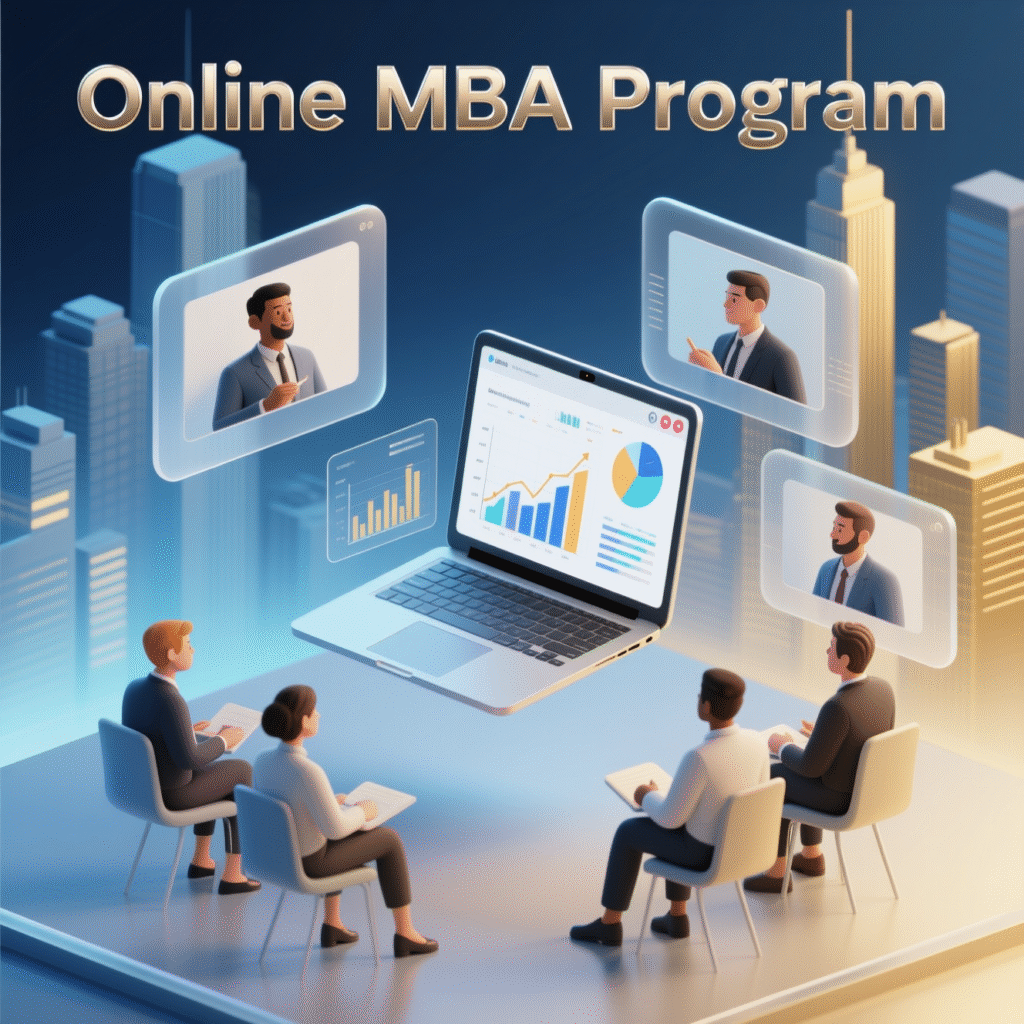
The MBA program at Global Eduvarsity prepares students with advanced business knowledge, leadership skills, and industry-focused expertise. With flexible learning, expert faculty, and global exposure, it empowers professionals to excel in management, entrepreneurship, and corporate leadership.
Online MBA Program
The MBA program at Global Eduvarsity prepares students with advanced business knowledge, leadership skills, and industry-focused expertise. With flexible learning, expert faculty, and global exposure, it empowers professionals to excel in management, entrepreneurship, and corporate leadership.
Degree
Full Form
Duration
Eligibility
Semester Fee
postgraduate
Master of Business Administration.
between 1 to 2 years
Bachelor's degree
₹4,000 to ₹50,000
Degree
Full Form
Duration
Eligibility
Semester fee
Postgraduates
Master of Business Administration
Between 1 to 2 years
Bachelor's degree
₹25,000 to ₹50,000
What Is Online MBA Course?
An Online MBA (Master of Business Administration) is a postgraduate management program that allows students and working professionals to pursue advanced business education through virtual learning platforms. Unlike traditional classroom-based programs, an online MBA offers flexibility, affordability, and accessibility, making it possible to balance studies with work or personal commitments.
It covers core areas such as finance, marketing, human resources, operations, entrepreneurship, and international business, while also providing opportunities for networking, case studies, and industry projects. Recognized globally, an online MBA equips learners with the skills and credentials needed for leadership roles, career advancement, or entrepreneurial ventures.
Online MBA Course Overview
An Online MBA (Master of Business Administration) is a flexible, digitally delivered program designed for working professionals and aspiring leaders. It combines core business fundamentals with specialized electives, enabling students to enhance managerial, analytical, and leadership skills without pausing their careers. The program typically includes interactive classes, case studies, and real-world projects, preparing graduates for global business challenges.
| Component | Details |
|---|---|
| Duration | 1 – 2 years (varies by university) |
| Mode of Study | 100% Online / Hybrid (Live + Recorded) |
| Core Subjects | Finance, Marketing, Strategy, Operations, Leadership, HR |
| Electives | Data Analytics, Entrepreneurship, Digital Marketing, Supply Chain, Healthcare Mgmt. |
| Learning Methods | Live lectures, recorded sessions, case studies, group projects, simulations |
| Eligibility | Bachelor’s degree + work experience (1–3 years preferred) |
| Assessment | Assignments, quizzes, exams, capstone projects |
| Accreditation | AACSB / EQUIS / AMBA (varies by institution) |
| Career Outcomes | Managerial roles, Consulting, Entrepreneurship, Finance, Tech leadership |
Eligibility Criteria and Duration for MBA Online Learning
Eligibility for MBA Online Learning typically requires a bachelor’s degree in any discipline from a recognized university, with some programs also preferring relevant work experience. The duration usually ranges from 1 to 2 years, depending on the university and whether it is pursued full-time or part-time.
Eligibility of MBA Degree Course
| Criteria | Details |
|---|---|
| Educational Qualification | Bachelor’s degree (minimum 3 years) in any discipline (Arts/Science/Commerce/Engineering/Management, etc.) from a recognized university. |
| Minimum Marks | 50% aggregate (45% for reserved categories like SC/ST/OBC in most universities). |
| Final Year Students | Candidates appearing in the final year of graduation are also eligible (subject to completion before admission deadline). |
| Entrance Exams | Most institutes require valid scores in exams such as CAT, XAT, MAT, CMAT, GMAT, NMAT, SNAP, or university-level tests. |
| Work Experience | Not mandatory, but preferred in executive MBA programs (usually 2–5 years of work experience required). |
| Age Limit | No specific age limit (except some executive programs may have age criteria). |
| Other Requirements | Group Discussion (GD), Personal Interview (PI), and/or Written Ability Test (WAT) may be part of the selection process. |
Duration of Online MBA
| Program Type | Minimum Duration | Maximum Duration |
|---|---|---|
| Accelerated Online MBA | 12 months (1 year) | 18 months (1.5 years) |
| Full-Time Online MBA | 18 months (1.5 years) | 24 months (2 years) |
| Part-Time Online MBA | 24 months (2 years) | 48 months (4 years) |
| Executive Online MBA | 12 months (1 year) | 24 months (2 years) |
Advantages of an Online MBA Degree
An online MBA degree offers flexibility, allowing students to study from anywhere and balance work, personal life, and education. It is often more affordable than traditional programs and provides access to a wide range of specializations. Online MBA programs also enhance digital skills, expand professional networks, and help career advancement without interrupting current employment.
| Advantage | Description |
|---|---|
| Flexibility | Study anytime, anywhere, balancing work, family, and education. |
| Cost-Effective | Often more affordable than traditional on-campus MBAs. |
| Career Continuity | Learn without taking a career break. |
| Global Networking | Connect with peers and professors from different countries. |
| Diverse Learning Tools | Access to online resources, simulations, and case studies. |
| Accessibility | No need to relocate; available to students worldwide. |
| Skill Application | Apply learned concepts directly to current job. |
Why Should You Pursue MBA from Online Learning
An online MBA provides a flexible and accessible pathway for professionals to enhance their business acumen without pausing their careers. It allows learners to gain the same quality of education as traditional programs while enjoying the benefits of convenience, affordability, and global networking opportunities. With advancements in digital platforms, online MBA programs are now highly interactive, engaging, and recognized by top employers worldwide.
Key Benefits of an Online MBA:
- Flexibility: Learn at your own pace while balancing work, family, and studies.
- Affordability: Generally more cost-effective than on-campus programs, with reduced commuting and living expenses.
- Career Advancement: Opens doors to leadership roles, promotions, and salary growth.
- Global Networking: Connect with peers, faculty, and industry professionals from across the world.
- Skill Development: Build expertise in leadership, strategy, finance, and entrepreneurship.
- Accessibility: Learn from anywhere, anytime, with just an internet connection.
- Employer Recognition: Many online MBAs are accredited and valued by recruiters equally to traditional MBAs.
Top Online MBA Specializations
Top online MBA specializations include Finance, Marketing, Human Resource Management, Operations, Information Technology, Entrepreneurship, and Healthcare Management. These programs allow professionals to focus on their career goals while gaining strategic business knowledge, leadership skills, and industry-specific expertise—all with the flexibility of online learning.
| Specialization | Focus Area | Career Paths |
|---|---|---|
| Finance | Investment, corporate finance, risk management | Financial Analyst, Investment Banker, CFO |
| Marketing | Consumer behavior, digital marketing, brand strategy | Marketing Manager, Brand Strategist |
| Human Resources (HR) | Talent management, labor relations, organizational dev. | HR Manager, Talent Acquisition Lead |
| Operations Management | Supply chain, logistics, process optimization | Operations Manager, Supply Chain Director |
| Information Technology | IT strategy, digital transformation, systems management | IT Manager, CIO |
| Data Analytics | Business intelligence, predictive analytics | Data Analyst, Business Intelligence Lead |
| Entrepreneurship | Startup creation, innovation, venture capital | Founder, Business Development Manager |
| International Business | Global markets, cross-cultural management | Global Business Manager, Consultant |
| Healthcare Management | Hospital administration, healthcare policy | Healthcare Administrator, Policy Analyst |
| Strategy & Leadership | Corporate strategy, executive leadership | Management Consultant, Executive Roles |
Online MBA in Education – Course Syllabus Overview
The Online MBA in Education blends management principles with educational leadership, preparing professionals to lead academic institutions, design policies, and manage educational programs effectively. The curriculum integrates core business subjects with specialized courses in education management, spread across four semesters.
| Semester 1 |
|---|
| Foundations of Management, Principles of Education, Organizational Behavior, and Managerial Economics provide a strong base in both business and education. |
| Semester 2 |
|---|
| Focus on Human Resource Management, Educational Psychology, Marketing Management, and Research Methodology to bridge leadership and educational practices. |
| Semester 3 |
|---|
| Strategic Management, Educational Leadership, Financial Management in Education, and Curriculum Design prepare students for strategic decision-making roles. |
| Semester 4 |
|---|
| Specialization in Education Policy, Technology in Education, Project Management, and Dissertation/Capstone Project to apply learning in real-world contexts. |
MBA Specialization and Projects
MBA programs offer various specializations such as Marketing, Finance, Human Resources, Operations, IT, and International Business. These specializations allow students to focus on a specific area of management according to their career interests. Projects in MBA are practical assignments that help students apply theoretical knowledge to real-world business problems, such as market research, financial analysis, HR strategies, or process improvements. Together, specializations and projects give students both in-depth knowledge and hands-on experience, preparing them for professional roles in their chosen field.
1. Finance
- Focus: Corporate finance, investment banking, risk management, financial modeling.
- Project Ideas:
- Valuation of a listed company using DCF, multiples, and comparables.
- Risk-return analysis of equity portfolios.
- Designing a financial strategy for an SME/startup.
- Credit risk analysis for a bank.
2. Marketing
- Focus: Consumer behavior, branding, digital marketing, sales strategy.
- Project Ideas:
- Market entry strategy for a new product/service.
- Social media analytics and campaign effectiveness.
- Competitive analysis of branding strategies in FMCG.
- Customer segmentation using survey/primary research.
3. Human Resources (HR)
- Focus: Talent management, organizational behavior, leadership, training & development.
- Project Ideas:
- Employee engagement survey & action plan.
- Designing a performance appraisal system.
- HR analytics for attrition prediction.
- Diversity & inclusion impact study.
4. Operations & Supply Chain
- Focus: Process optimization, logistics, quality management.
- Project Ideas:
- Supply chain optimization for a manufacturing firm.
- Lean Six Sigma implementation case study.
- Demand forecasting using time-series models.
- Inventory management improvement project.
5. Information Technology / Business Analytics
- Focus: Data-driven decision-making, AI/ML applications, IT strategy.
- Project Ideas:
- Predictive analytics for customer churn.
- Business intelligence dashboard design.
- Sentiment analysis of customer reviews.
- ERP implementation challenges & solutions.
6. International Business
- Focus: Global trade, cross-border management, international marketing.
- Project Ideas:
- Foreign market entry strategy (case of a domestic company).
- Trade policy impact on a sector.
- Cross-cultural management practices.
- Export plan for an SME.
7. Entrepreneurship
- Focus: Startups, innovation, venture capital.
- Project Ideas:
- Business plan & financial model for a startup.
- Feasibility study for a new venture.
- Comparative analysis of startup incubators.
- Funding strategy for early-stage startups.
8. Healthcare / Pharma Management
- Focus: Hospital management, pharmaceutical strategy, healthcare analytics.
- Project Ideas:
- Patient satisfaction & service quality improvement study.
- Supply chain management in pharmaceuticals.
- Adoption of digital health solutions.
- Policy impact on healthcare delivery.
How Online MBA Exams are Conducted?
Online MBA exams are usually conducted through secure digital platforms provided by the university or exam partners. Students are required to log in at a scheduled time, and exams are monitored using proctoring software that may include webcam monitoring, screen recording, or AI-based tracking to ensure fairness. Some exams are objective (MCQs), while others involve case studies, essays, or project submissions.
Key Features of Online MBA Exams:
- Login & Authentication – Secure login with student ID verification.
- Proctoring – Live, recorded, or AI-based monitoring.
- Exam Format – MCQs, essays, case studies, or open-book assessments.
- Time-bound – Strict timers with automatic submission after expiry.
- Technical Checks – System requirements and stable internet needed.
- Submission – Auto-save and final submission options provided.
Top 10 Online MBA program in India and Abroad Universities/Colleges for Admission.
Online MBA—whether in India or abroad—it’s vital to look at global accreditations (like AACSB, AMBA, EQUIS), institutional reputation, and program flexibility. In India, top-distance programs from institutions like SPJIMR (triple-accredited), Amity (UGC-DEB, NAAC A+), and Great Lakes (AMBA) stand out. Internationally, online MBA programs at IE Business School (triple-accredited and ranked #1 by Financial Times), Imperial College (UK), Warwick Business School (UK), USC Marshall (USA), and UNSW-AGSM (Australia) consistently top rankings, delivering strong ROI, rich global networking, and modern, career-focused curricula.
| Institution | Location | Accreditation / Approval |
|---|---|---|
| SP Jain Institute of Management & Research | Mumbai, India | AACSB, EQUIS, AMBA (Triple Crown) |
| Amity University Online | Noida, India | UGC-DEB, AICTE, NAAC (A+), WES, AIU, ACU |
| Great Lakes Institute of Management | Chennai/Gurgaon, India | AMBA |
| NMIMS Global Access (CDOE) | Mumbai, India | UGC-approved (UGC) |
| Symbiosis Centre for Online Learning (SCDL) | Pune, India | UGC, NAAC A++ |
| Manipal University Online | Jaipur (and online) | UGC-DEB, AICTE, AIU; NAAC A+ |
| University of Illinois Urbana-Champaign (Gies iMBA) | Illinois, USA | AACSB |
| IE Business School (Global Online MBA) | Madrid, Spain | AACSB, AMBA, EQUIS |
| Warwick Business School (Distance Learning MBA) | Coventry, UK | AACSB, AMBA |
| Imperial College London – Global Online MBA | London, UK | AACSB, EQUIS, AMBA |
Entrance Exams for Online MBA Programs
Most online MBA programs require applicants to take standardized entrance exams like the GMAT or GRE, which assess quantitative, verbal, and analytical skills. However, many schools now offer test-optional policies or waive exam requirements for applicants with strong academic records, professional experience, or advanced degrees. This flexibility makes online MBA programs more accessible to working professionals seeking career advancement.
Types of Entrance Exams
National Exams
- A list of national-level entrance exams for MBA programs (for example, in India: CAT, XAT, MAT, CMAT, etc.)?
- Or details about international exams commonly accepted for MBA admissions worldwide (like GMAT, GRE, TOEFL/IELTS for English proficiency)?
- Or country-specific MBA entrance exam requirements?
University-Specific Exams
Apart from national-level exams like CAT, XAT, and GMAT, many universities in India and abroad conduct their own entrance tests for MBA admissions. These university-specific exams assess aptitude, reasoning, and business awareness, serving as a direct gateway to their respective institutions. In India, leading institutes such as IIFT, NMIMS, and Symbiosis have their own tests, while globally, schools like Stanford and Harvard rely mainly on GMAT/GRE scores but also follow institution-specific admission processes including essays, interviews, and analytical tests.
| Region | University/Institute | Exam Name/Process | Details |
|---|---|---|---|
| India | KIIT School of Management | KIITEE Management | MBA admissions at KIIT University |
| Abroad | IE Business School (Spain) | IE Global Admissions Test (ieGAT) | In-house test for candidates without GMAT/GRE |
| India | Christ University | CUET (Christ University Entrance Test) | Entrance for MBA programs |
| Abroad | London Business School (UK) | GMAT/GRE + LBS-specific interviews | Focus on profile-based selection |
| India | Symbiosis International (Deemed University) | SNAP | For MBA programs under Symbiosis institutes |
| Abroad | INSEAD (France/Singapore) | GMAT/GRE + INSEAD Assessment | Includes essays, recommendations, interviews |
| India | Stanford GSB (USA) | GMAT/GRE + Essays & Interviews | Holistic admission process |
Entrance Exam Scores and Waivers
Entrance exam scores like GMAT, GRE, or CAT are often key requirements for MBA admissions, as they help schools assess applicants’ quantitative, analytical, and verbal skills. However, many programs now offer waivers for candidates with strong academic records, significant professional experience, or advanced degrees, allowing them to apply without test scores. This flexibility makes MBA programs more accessible while still ensuring high admission standards.
Waivers for Entrance Exams
Many MBA programs offer waivers for entrance exams like the GMAT or GRE to applicants who meet certain criteria. These waivers are typically granted to candidates with strong academic backgrounds, significant professional experience, advanced degrees, or high undergraduate GPAs. Schools may also provide waivers to encourage applications from diverse or non-traditional candidates. This allows qualified professionals to apply without the added hurdle of standardized testing.
Tips for Preparing for Entrance Exams
- Understand the Exam Pattern – Know the structure, sections, marking scheme, and time limits.
- Know the Syllabus – Focus on Quantitative Aptitude, Verbal Ability, Logical Reasoning, and General Awareness (varies by exam).
- Create a Study Plan – Make a realistic daily and weekly schedule.
- Strengthen Basics – Build a strong foundation in mathematics and grammar.
- Practice Regularly – Solve topic-wise questions and gradually move to full-length tests.
- Take Mock Tests – Simulate exam conditions to build stamina and time management.
- Analyze Performance – Review mistakes and work on weak areas.
- Work on Speed & Accuracy – Use short-cuts, mental math, and efficient reading techniques.
- Read Daily – Improve vocabulary and comprehension by reading newspapers, journals, and business magazines.
- Stay Updated with Current Affairs – Useful for general awareness and interviews.
- Use Quality Study Material – Standard books and online resources rather than too many random sources.
- Focus on Time Management – Practice allocating time per section effectively.
- Revise Regularly – Keep revising important formulas, vocabulary, and concepts.
- Join Study Groups – Discussing with peers can give new perspectives and motivation.
- Stay Healthy – Proper sleep, balanced diet, and exercise help with focus.
- Stay Positive & Confident – Keep a calm mindset, especially near exam day.
Admission Procedure for MBA Online Universities
The admission process for Ph.D. online programs is designed to assess a candidate’s academic background, research potential, and alignment with the university’s areas of expertise. While procedures vary by institution, most follow a similar sequence that includes application submission, proposal evaluation, interviews, and final selection. Accreditation and program credibility should be verified before applying.
| Step | What to Do |
|---|---|
| 1. Research | Confirm accreditation, program structure, and delivery features |
| 2. Eligibility Check | Ensure bachelor’s qualification, marks criteria, possibly work experience or test scores |
| 3. Prepare Documents | Academic records, ID, proofs, experience letters, entrance scores, resume |
| 4. Apply Online | Register, fill form, upload documents, pay fee |
| 5. Follow-Up | Respond to shortlisting, prepare for interviews if needed |
| 6. Accept Offer | Pay fee, enroll, and attend orientation |
Who Can Apply for MBA Online Learning Courses?
Anyone interested in advancing their management and leadership skills can apply for MBA online learning courses, though eligibility usually depends on academic qualifications and professional experience. These programs are designed for working professionals, entrepreneurs, and graduates seeking flexibility while pursuing higher education.
Who Can Apply:
- Bachelor’s degree holders from a recognized university
- Working professionals seeking career growth
- Entrepreneurs and business owners
- Individuals looking to switch careers into management
- International students meeting admission requirements
- Fresh graduates (some programs may require work experience)
Online MBA Acceptable in the Job Market?
An online MBA is generally acceptable in today’s job market, provided it is earned from an accredited and reputable institution. Employers increasingly recognize the value of online programs, especially since many universities now offer the same curriculum, faculty, and networking opportunities as their on-campus counterparts. The flexibility of online MBAs is also seen as a strength, as it demonstrates time management, discipline, and the ability to balance multiple responsibilities. However, acceptance may vary depending on industry, company culture, and the school’s ranking. Top-tier online MBA programs usually carry strong recognition, while lesser-known or unaccredited programs may face skepticism. Networking opportunities, internships, and alumni connections can also influence how employers perceive an online MBA.
Factors Affecting Acceptance of Online MBAs in the Job Market:
- Accreditation – Degrees from AACSB, AMBA, or EQUIS-accredited schools are widely respected.
- School Reputation – Programs from top universities (e.g., Wharton, INSEAD, London Business School) carry weight whether online or on-campus.
- Industry Standards – Consulting, finance, and elite firms may prefer traditional MBAs; tech and flexible industries are more open.
- Curriculum & Faculty – Online MBAs with the same courses and professors as the on-campus program are seen as equivalent.
- Networking Opportunities – Strong alumni networks, residencies, and career support increase value.
- Soft Skills Signal – Online learning shows independence, adaptability, and self-motivation.
- Employer Perception – Some employers may still favor in-person MBAs, especially in competitive fields.
- Program Tier – Lower-ranked or unaccredited online MBAs may be undervalued.
Job Opportunities After Online MBA
An online MBA opens doors to diverse career opportunities across industries. Graduates gain leadership, management, and strategic skills that prepare them for roles in business, finance, consulting, marketing, and operations. Employers increasingly value online MBAs, making it a flexible and credible option for advancing one’s career.
| Job Role | Average Salary (Approx.) | Key Skills Required | Common Industries |
|---|---|---|---|
| Business Manager | $70,000 – $120,000 | Leadership, Strategy, Planning | Corporate, Startups |
| Marketing Manager | $65,000 – $115,000 | Branding, Digital Marketing | FMCG, Tech, Retail |
| Financial Analyst | $60,000 – $100,000 | Data Analysis, Finance, Excel | Banking, Investment |
| HR Manager | $60,000 – $110,000 | Talent Management, HR Strategy | Corporate, Consulting |
| Operations Manager | $65,000 – $115,000 | Process Optimization, Logistics | Manufacturing, Services |
| Management Consultant | $80,000 – $140,000 | Problem-Solving, Analytics | Consulting Firms |
| Entrepreneur/Founder | Varies Widely | Innovation, Business Strategy | Startups, All Sectors |
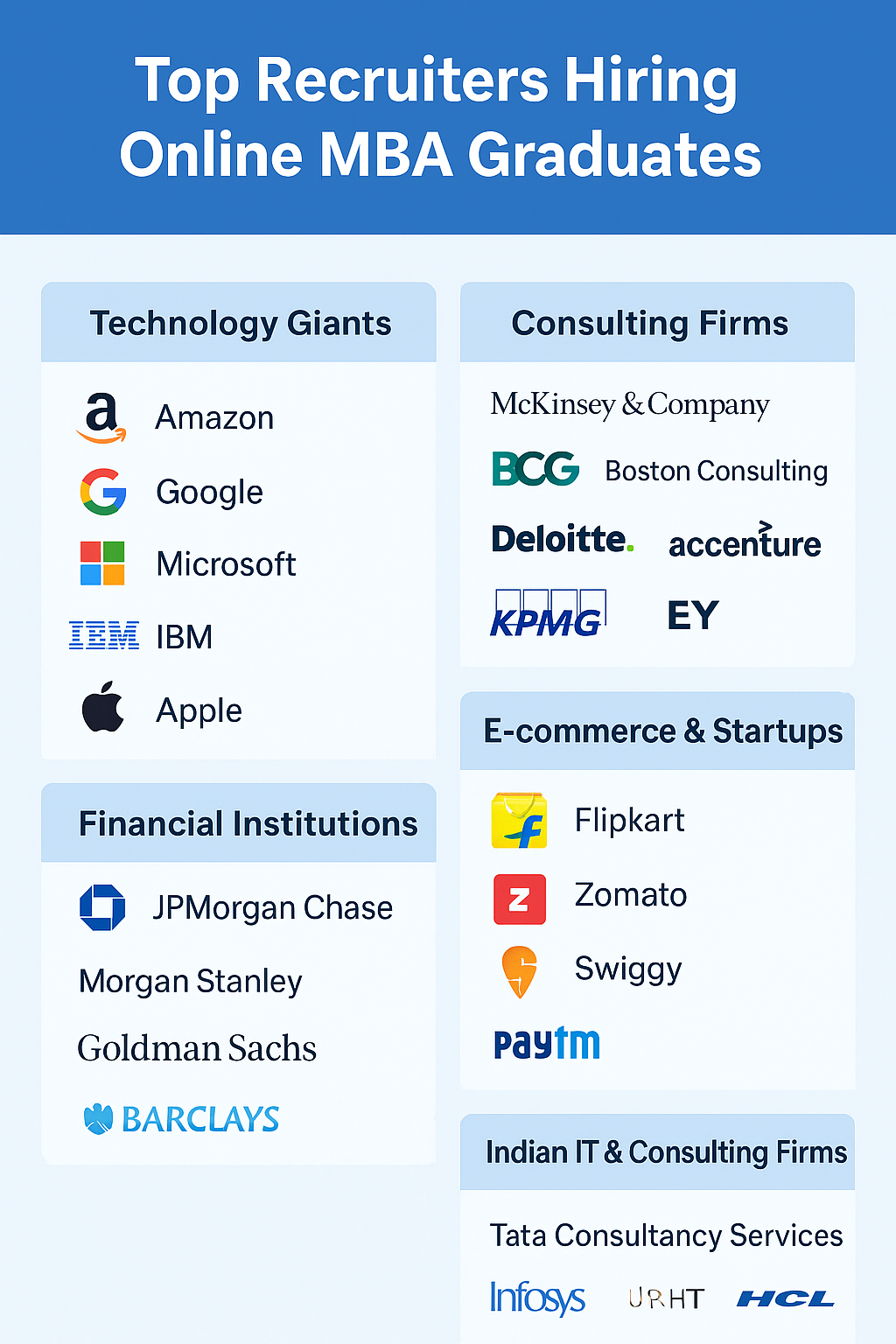
Top Recruiters Hiring Online MBA Graduates
Online MBA graduates are increasingly sought after by leading companies across sectors such as consulting, technology, finance, and FMCG. These recruiters value the strategic, analytical, and leadership skills developed through online MBA programs, making graduates ideal candidates for managerial and leadership roles.
| Sector | Top Recruiters |
|---|---|
| Consulting | McKinsey, BCG, Deloitte, Accenture |
| Technology | Google, Microsoft, Amazon, IBM |
| Finance & Banking | JPMorgan Chase, Goldman Sachs, Citi, HSBC |
| FMCG | Unilever, Procter & Gamble, Nestle, PepsiCo |
| Healthcare | Johnson & Johnson, Pfizer, Novartis |
| E-commerce | Flipkart, Amazon, Alibaba |
FAQs - Frequently Asked Questions
Q1. Can an MBA really transform the way I think about business?
Yes! An MBA isn’t just about learning tools—it’s about reshaping your mindset. You’ll learn to approach problems strategically, think globally, and evaluate risks and opportunities from multiple perspectives. Think of it as a mental upgrade, not just a credential.
Q2. Is networking the real secret sauce of an MBA?
Partly—but it’s not just about collecting contacts. The magic happens when you build relationships with peers, professors, and industry leaders who challenge your assumptions and push you out of your comfort zone. The network is valuable, but how you engage with it defines the impact.
Q3. Can I still pursue my passion if it doesn’t seem “business-y”?
Absolutely! MBAs today encourage cross-disciplinary exploration. Whether it’s social entrepreneurship, art, technology, or sustainability, you’ll learn how to turn passion into strategy and measurable impact. Your MBA can amplify what you care about, not force you into a cookie-cutter path.
Q4. Is an MBA worth it in a world full of online courses and self-learning?
Think of an MBA as a full-immersion lab. Online courses teach skills, but an MBA teaches application, collaboration, leadership, and critical thinking—all in real time with real people. It’s the difference between knowing the recipe and running a full kitchen.
Q5. How do I make the most of my MBA beyond the classroom?
Dive into real-world projects, start clubs or initiatives, volunteer for leadership roles, and engage with your alumni network. The classroom is just the starting point—the real learning comes from doing, failing, iterating, and leading in diverse environments.